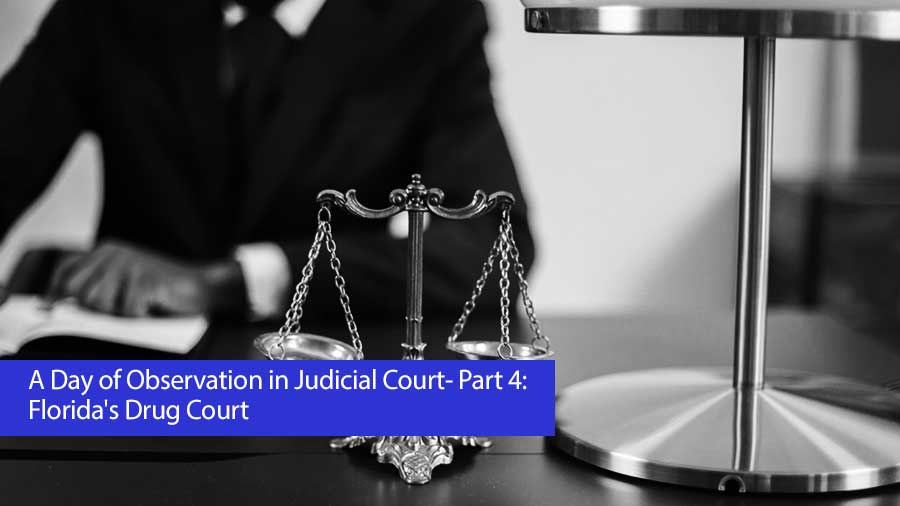
With an hour to kill in between pre-trial sessions, Chris and I sat on a second-floor bench and waited. People slowly began to assemble around us, many of them chatting like old friends. One woman congratulated another on her last day in court. The woman thanked her and seemed excited, saying it was a long time coming. Curious about their interaction, we followed them into a new courtroom. The seats were full, and multiple large television screens showed Zoom participants joining virtually. We rose as Judge Elizabeth A. Blackthorn entered the room, and sat as she instructed. She immediately welcomed everyone and congratulated two program participants for graduating. The seats erupted in applause and cheers at the announcement.
Once called to the stand, the graduates made statements about how effective the program has been for their recovery. They shared future goals, such as staying sober and continuing to work hard at their jobs. At this point, our suspicions were confirmed: drug court. Once the graduates accepted their certificates and left, another woman was called to the stand. After a brief conversation about career ambitions, Judge Blackthorn enthusiastically congratulated the woman on “leveling up” to the fourth phase of the program and for continuously chipping away at the 500 required community service hours.
The participant was awarded a certificate for reaching phase four and exited the courtroom to a shower of applause. A male participant was then called to the stand and asked to share his recent good deed with the court. The man shared that, while on his way to court, he met a blind man with a walker and dementia who’d been robbed by a cab driver. He helped the man into a Burger King, called the police, tracked the cab driver, and managed to return the stolen wallet. Judge Blackthorn was impressed and awarded him the “Caught in the Act” reward for being spotted doing a kind deed for another. She motioned to a large wheel in the middle of the courtroom, a prize wheel, which he spun and won a $15 Dunkin Donuts gift card. I was inspired by this moment and the support shown by everyone in the room. They’re united by experience with substance use, whether direct or second-hand, and every step is celebrated as the win it rightfully is.
Upon further research, the St. Johns County Drug Court program is for non-violent adults with drug-related felony charges who are struggling with addiction. According to the St Johns County Adult Drug Court Brochure (n.d), the program motto is “Visualizing a Brighter Future” with emphasis on working together over a year to succeed through five phases. Phase one lasts a minimum of two months and requires one weekly court appearance, intense supervision, weekly drug tests, and three group therapy sessions per week. The second phase is the same, except it lasts a minimum of four months with moderate supervision and a court appearance every other week. Phases three and four further reduce court appearances and group therapy requirements while maintaining weekly drug tests and moderate supervision. The fifth phase occurs once the participant is awaiting graduation and reduces the drug testing to random rather than weekly. The St Johns County Adult Drug Court Brochure (n.d) states that within three years of completing the program, 82% of participants avoid felony charges, and 85% avoid drug-related charges.