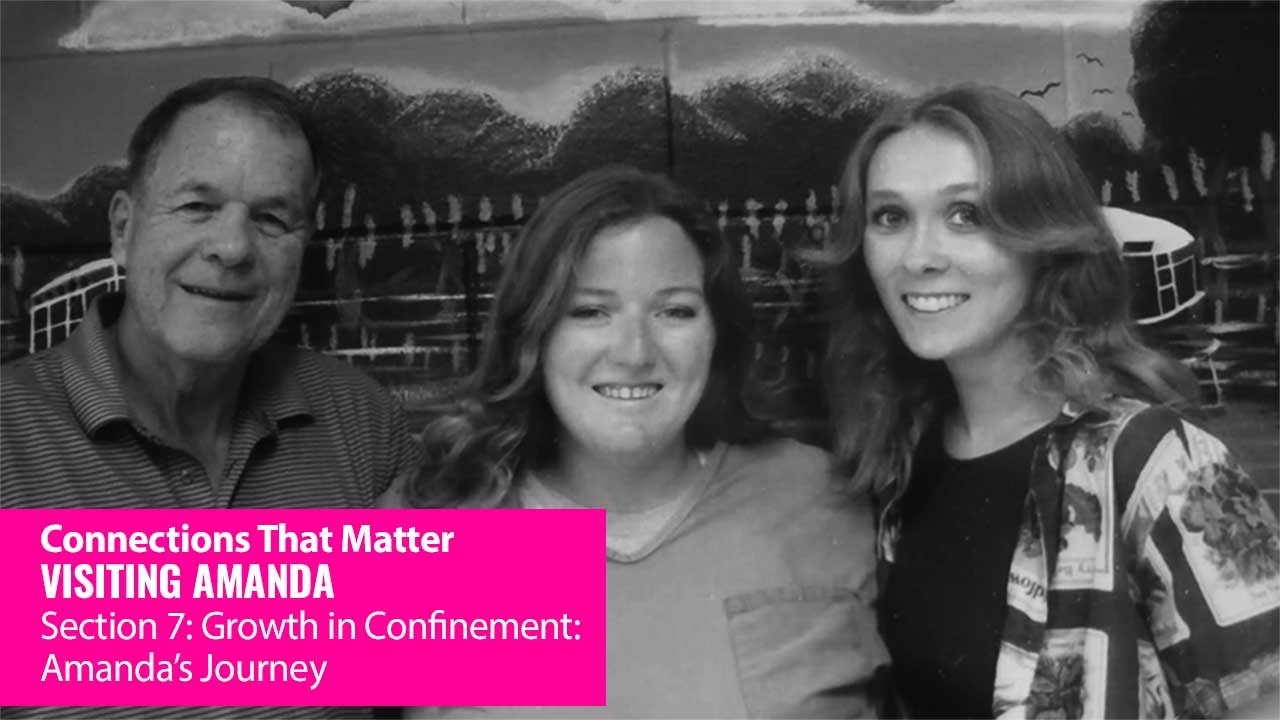
Amanda, an intelligent and affable woman, has used her strengths to find people and resources that best support her through her sentence. “Connections are everything,” she confirmed, emphasizing that kindness and good behavior can get you far in any situation. Her good behavior is what enabled her to secure a spot at the Work Camp, where she traded a cell for a dorm, no air conditioning for air conditioning, and limited cold showers for unlimited hot showers.
“It’s easy to spot others like me because they don’t fit the mold,” she noted, meaning inmates charged with DUI homicide who are non-violent and rarely cause issues.
Her packages are delivered quickly because she has established a good rapport with the officer who handles their distribution. An avid reader hungry for knowledge, Amanda mostly looks forward to books coming in the mail. She will read anything, but mostly enjoys autobiographies and self-help books, such as “Letters to the Universe” by Malcolm Ivey, a man who wrote inspiring letters and essays while incarcerated. Inmates read frequently and are constantly swapping books with each other, so there’s always something new to read around the dorm.
Besides packages and books, Amanda’s best friend works at the commissary, so she has frequent access to better food and hygiene products. Inmates get creative with their food in prison, using commissary ingredients to make recipes such as cake and pizza. Amanda even made a cheesecake for Christmas to share with visitors, something Chris still jokes about, as he wasn’t a fan. I asked her if the slate blue prison-issued shirt and pants were comfortable, and she shrugged, saying that her clothes were much better than when she first arrived because her roommate sews and made comfier adjustments.
At the time of my visit, I was taking a college class on the philosophy of stoicism that gave me some insight into Amanda’s character. The Stoics, contrary to popular belief, do not believe in being void of all emotion, good or bad, but rather in eliminating negative emotion. It involves separating from material items as a condition of your happiness, and emphasizing your mind and the things that cannot be taken from you, such as your morality and character.
Anything outside of our control, including the control of external possessions, isn’t ours to worry about because they were never truly ours. A man living on the street who came from a life of riches can still find happiness by focusing on what he does have rather than what he doesn’t.
After all, it could always be worse; he could be dead. Many of the great Stoics, including Seneca, Rufus, and Epictetus, delved deeper into practicing Stoicism when they were exiled from Rome for being philosophers. They didn’t complain or fall into despair over this exile, because nothing they based their happiness on was impacted in the slightest. Prison is the same, a type of social exile that tests an individual’s ability to find happiness within its walls. By relying on your own mind and working on your character, it can become a shaping experience that benefits you in the long run.
Amanda’s attitude and demeanor reflect this tried-and-true method of finding joy in the worst of circumstances. She has surrounded herself with friends, busied herself with teaching other inmates, found a passion for Volleyball, and strengthened her character daily through books and her faith in God. Humor is her standout quality, a light in the dark that comforted me throughout my time inside the barbed wire fence.
This development extends to her ability to set boundaries and hold her own, albeit respectfully. “No is a full sentence,” she told me, recalling who she was before prison as a pushover who struggled with setting boundaries. She recalled her life on social media, how simple it was to block someone with the click of a button, never to interact again. “You can’t do that here; you don’t have a choice.” She put it plainly: in prison, you have to eat, shower, shit, and sleep with the same people, and there’s no escape. Boundary setting is essential, especially for lifers who will be there unquestionably throughout your stay.
Amanda is now much more comfortable holding her own, saying no, and expecting respect from fellow inmates when a line is drawn in the sand. This has strengthened her ability to advocate for herself, speaking up and seeking a solution when a tablet she spent months waiting for broke randomly. These tablets are important, as physical letters or cards from family members are no longer given to inmates, but photocopied and sent to their tablets. Amanda, despite being rightfully disappointed, exercised patience and understanding while the tablet was fixed, being able to rely on her good connections in a time of need.