The first sobriety test is the horizontal gaze nystagmus, meaning involuntary eye movement, which involves following the officer’s finger with your eyes while keeping your head still. Unlike coordination tests, which, depending on the person, can be performed well while intoxicated, this test is impossible to fake. The cerebellum is a region of the brain that regulates movement, balance, and coordination, including gaze stability, and is heavily impacted by alcohol (Romano et al., 2017). This is why walking straight is difficult, and smooth eye movements become jerky while intoxicated. This gaze instability is an involuntary response to intoxication that officers are trained to detect. I followed the officer’s finger with my eyes, up and down, left and right, and failed the test due to my inability to maintain smooth eye movements. Having learned about this test prior, I knew there was nothing I could do to improve my odds of passing. I simply kept my head as still as possible and followed his finger and instructions to the best of my ability. You cannot feel the difference between jerked and smooth eye movements while drunk, so it’s impossible to determine the results on your own. The officer was straightforward about my failure, though he would have kept that information to himself in a real scenario.
The second test was the walk and turn, which involves walking in a straight line heel-to-toe with your arms at your sides for nine steps, turning, and repeating the process in the direction you came. Embarrassingly, I was so focused on passing this test that I forgot to turn and continue walking. I walked the first nine steps, stopped, and waited for the officer’s next direction. He asked, “Do you think you completed that test?” I said yes, but realized that even in a controlled environment, my nerves got the best of me. It shows that even when the stakes are low, the sobriety tests can rattle anyone. When that nervous feeling creeps in and pressure takes hold, it becomes difficult to process information and perform tasks effectively.
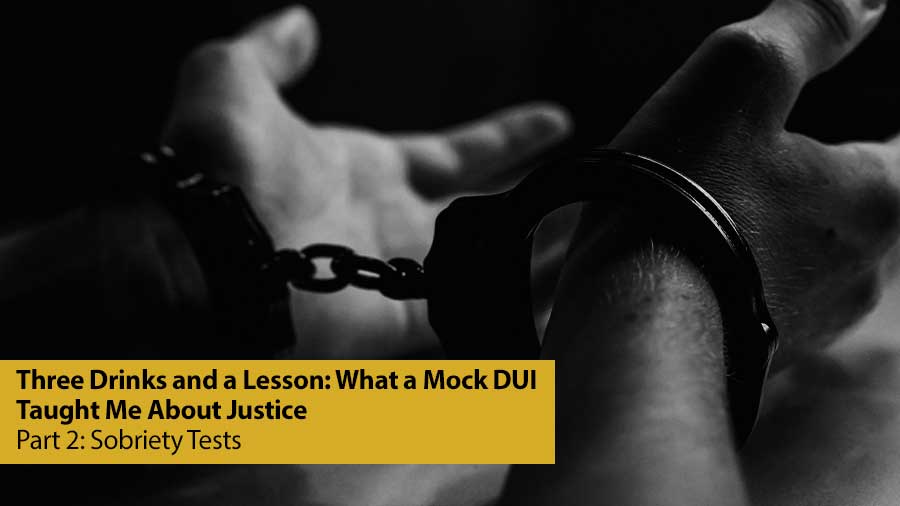
The third and final test before the breathalyzer was the one-leg stand. The officer had me lift my foot six inches off the ground, keep my arms down, and count out loud “one one-thousand, two one-thousand, three one-thousand” and onward until he gave the okay to stop. I counted up to 20, maintaining a steady balance throughout, and passed the final test. Though this test was successful, the others were not, and the officer concluded that I was likely intoxicated. He pulled dark gray handcuffs from his utility belt, asked me to put my hands behind my back, and cuffed my wrists. Traditional police handcuffs are attached with a chain and have one lock, but most officers now use double-lock cuffs with three-hinge attachments to further limit the range of motion for those in custody. He kept them as loose as possible and checked frequently on my comfort, but the metal still bit into my wrists. There was an additional weight to the handcuffs that extended beyond the dense metal. It’s what they stand for, losing the very thing we cherish most, freedom. I could imagine, in a real DUI situation, feeling as though everything in my life would change, but not being able to process all the possibilities in the moment. Will I have my license? Will my friends and family still love me? Will I go to jail? Will I lose my car? Those questions can only be answered with time, which is an overwhelming thought.